Monday, April 18, 2016

Origins of the Cold War

In my opinion, the USSR/Soviets were responsible for the start of the Cold War.
Although it is very true that the United States tried to show dominance and fear through the usage of the atomic bomb, it was not the USSR's job to stand up to the US, creating their own nuclear bombs and reneging on their agreements to allow the people of Eastern Europe to determine their own fates(by imposing totalitarian rule on territories behind the "Iron Curtain").
The Soviet Union promised to free elections in Poland and in the other East European countries. However in 1947(which is initially when the free election was to happen), most of the Socialist and Polish Peasant Party candidates were sent to jail. The ones that supported them were subdue'd by the secret police. 
They continuously showed aggressive expansion, eventually forcing other nations to help the US control this country from becoming an uncontrollably powerful nation.


There are two documents I found to be non-trustworthy. The Truman Doctrine is told by President Truman to Congress. It is biased because it states how the United States is the "protecting force of freedom and peace," which is not entirely true - towards the end of the Cold War, the United States only becomes more and more similar to the USSR. The audience is Congress, who make the political choices in the United States. To convince Congress, some facts were probable to be enlarged in order to manipulate choices the way Truman would have wanted. The Iron Curtain Speech is told by Winston Churchill to the citizens of Missouri. Great Britain and the United States were anti-communist. "In a great number of countries, far from the Russian frontiers and throughout the world, Communist fifth columns are established and work in complete unity and absolute obedience to the directions they receive from the communist center." 

Thursday, April 7, 2016

Anne Frank - Two Steps from Hell - Sons of War


A young Jewish girl named Anne Frank (1929-1945), her parents and older sister moved to the Netherlands from Germany after Adolf Hilter and the Nazis came to power there in 1933 and made life increasingly difficult for Jews. In 1942, Frank and her family went into hiding in a secret apartment behind her father’s business in German-occupied Amsterdam. The Franks were discovered in 1944 and sent to concentration camps; only Anne’s father survived. Anne Frank’s diary of her family’s time in hiding, first published in 1947, has been translated into almost 70 languages and is one of the most widely read accounts of the Holocaust. Two Steps from Hell - Sons of War is a good song that represents Anne Frank. The song creates a certain hidden suspense that represents Anne Frank and her family’s hiding from the Nazis. One could picture Anne Frank furiously writing away on her diary as she struggles to survive from Hitler’s reign.
https://www.ushmm.org/lcmedia/photo/lc/image/61/61768.jpg

Bombing of Nagasaki/Hiroshima - Attack on Titan - Vogel im Käfig


On August 6, 1945, during World War II (1939-45), an American B-29 bomber dropped the world’s first deployed atomic bomb over the Japanese city of Hiroshima. The explosion wiped out 90 percent of the city and immediately killed 80,000 people; tens of thousands more would later die of radiation exposure. Three days later, a second B-29 dropped another A-bomb on Nagasaki, killing an estimated 40,000 people. Japan’s Emperor Hirohito announced his country’s unconditional surrender in World War II in a radio address on August 15, citing the devastating power of “a new and most cruel bomb.” Attack on Titan - Vogel im Käfig is a good song that represents this event. The song almost creates a slow motion image in your head of the innocent citizens of Hiroshima and Nagasaki suffering both during and after the bomb dropped.

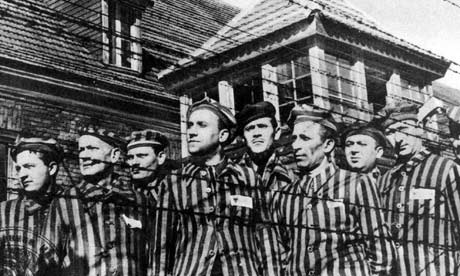
The Holocaust - Two Steps from Hell - Starfall


Since 1945, the word has taken on a new and horrible meaning: the mass murder of some 6 million European Jews (as well as members of some other persecuted groups, such as Gypsies and homosexuals) by the German Nazi regime during the Second World War. To the anti-Semitic Nazi leader Adolf Hitler, Jews were an inferior race, an alien threat to German racial purity and community. After years of Nazi rule in Germany, during which Jews were consistently persecuted, Hitler’s “final solution” – now known as the Holocaust – came to fruition under the cover of world war, with mass killing centers constructed in the concentration camps of occupied Poland. Two Steps from Hell - Starfall is a great song that describes this event well. The song has a dim, depressing tone to it, displaying the pictures of millions of Jews suffering from Nazi Germany’s so-called “Final solution.”

Japanese Internment Camps - Two Steps from Hell - Strength of a Thousand Men


Two months after the Japanese bombing of Pearl Harbor, U.S. President Franklin D. Roosevelt signed Executive Order 9066 ordering all Japanese-Americans to evacuate the West Coast. This resulted in the relocation of approximately 120,000 people, many of whom were American citizens, to one of 10 internment camps located across the country. Traditional family structure was upended within the camp, as American-born children were solely allowed to hold positions of authority. Some Japanese-American citizens of were allowed to return to the West Coast beginning in 1945, and the last camp closed in March 1946. In 1988, Congress awarded restitution payments to each survivor of the camps. Two Steps from Hell - Strength of a Thousand Men is a good representation of this event. Before even listening to the song, the title itself gives off an impression of joined effort. Once you listen to the song, it creates an image of all the Japanese in internment camps working together to survive this war.

D-Day - Two Steps from Hell - Protectors of the Earth


During World War II (1939-1945), the Battle of Normandy, which lasted from June 1944 to August 1944, resulted in the Allied liberation of Western Europe from Nazi Germany’s control. Codenamed Operation Overlord, the battle began on June 6, 1944, also known as D-Day, when some 156,000 American, British and Canadian forces landed on five beaches along a 50-mile stretch of the heavily fortified coast of France’s Normandy region. The invasion was one of the largest amphibious military assaults in history and required extensive planning. Prior to D-Day, the Allies conducted a large-scale deception campaign designed to mislead the Germans about the intended invasion target. By late August 1944, all of northern France had been liberated, and by the following spring the Allies had defeated the Germans. The Normandy landings have been called the beginning of the end of war in Europe. For this event I chose the song Two Steps From Hell - Protectors of the Earth. The song creates a suspenseful, “hype-producing” atmosphere that fits D-Day’s description and situation very well.

Nazi Germany - Elena Siegman - 115

At the beginning of the 1930s, Adolf Hitler’s Nazi Party exploited widespread and deep-seated discontent in Germany to attract popular and political support. There was resentment at the crippling territorial, military and economic terms of the Versailles Treaty, which Hitler blamed on treacherous politicians and promised to overturn. The democratic post-World War I Weimar Republic was marked by a weak coalition government and political crisis, in answer to which the Nazi party offered strong leadership and national rebirth. From 1929 onwards, the worldwide economic depression provoked hyperinflation, social unrest and mass unemployment, to which Hitler offered scapegoats such as the Jews. In other words, Hitler and Nazi Germany was a group of evil  that represented violence. They killed millions of Jews, and took over many countries without any warning.

The song I chose for this group was Elena Siegman - 115. This is one of the most brutal songs I know. The brutal lyrics enforce thoughts of violence and murder(e.g. “I’ll stop you from breathing and all your deceiving”) This song is also coincidentally the easter egg song of a Nazi Zombie video game, Black Ops Zombies.

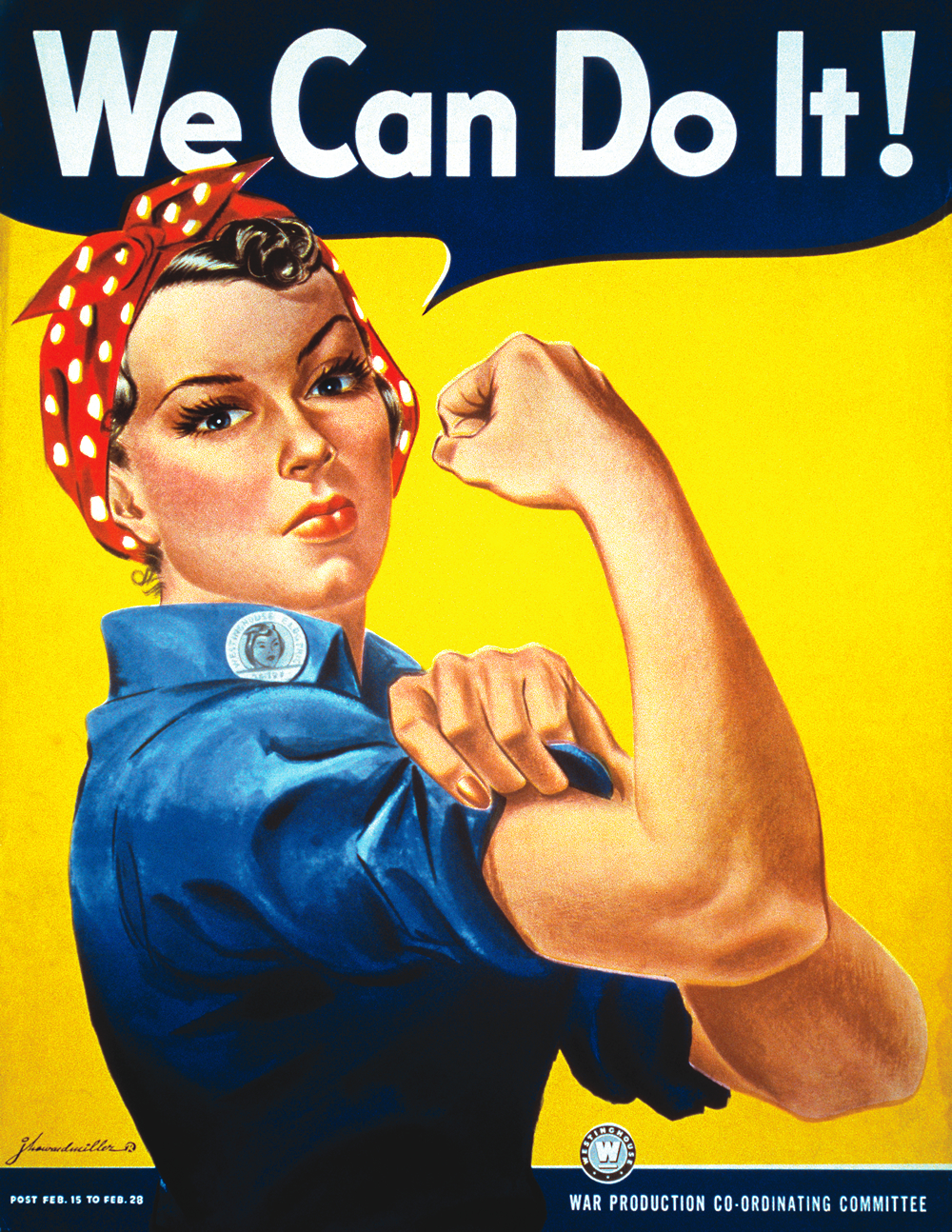
Rosie the Riveter - Imagine Dragon - Warriors


Rosie the Riveter is one of the most famous symbols created in the US during the second World War. Rosie defined the American spirit, the need for everyone to help the United States win the war. American women entered the workforce in unprecedented numbers during World War II, as widespread male enlistment left gaping holes in the industrial labor force. Between 1940 and 1945, the female percentage of the U.S. workforce increased from 27 percent to nearly 37 percent, and by 1945 nearly one out of every four married women worked outside the home. “Rosie the Riveter,” star of a government campaign aimed at recruiting female workers for the munitions industry, became perhaps the most iconic image of working women during the war.

The song I chose that represents Rosie the Riveter is Imagine Dragons - Warriors. This song starts off as, “As a child you would wait, and watch from far away. But you always knew that you'd be the one that work while they all play.” This encourages the listener to start working, much similar to the purpose of Rosie. The chorus of this song is, “Here we are, don't turn away now, We are the warriors that built this town. Here we are, don't turn away now, We are the warriors that built this town. From Dust.” “Here we are” is showing the absolute truth to the Americans, that every American is currently at war. “Don’t turn away now” is influencing the Americans to stay and help fight the war. “We are the warriors that built this town.” Means that every American helped create the United States. Therefore, it is their duty to protect it.

Pearl Harbor - Goreshit - Burn this moment into the Retina of my Eye

The bombing of Pearl Harbor was essentially the reason why the United States participated in World War II. 8 a.m. on December 7, 1941, hundreds of Japanese fighter planes attacked the American naval base at Pearl Harbor near Honolulu, Hawaii. The barrage lasted just two hours, but it was devastating: The Japanese managed to destroy nearly 20 American naval vessels, including eight enormous battleships, and more than 300 airplanes. More than 2,000 Americans soldiers and sailors died in the attack, and another 1,000 were wounded. The day after the assault, President Franklin D. Roosevelt asked Congress to declare war on Japan; Congress approved his declaration with just one dissenting vote. Three days later, Japanese allies Germany and Italy also declared war on the United States, and again Congress reciprocated. More than two years into the conflict, America had finally joined World War II. To end the war, the United States dropped two nuclear bombs on Hiroshima and Nagasaki, forcing Japan to surrender.

I chose Goreshit - Burn this moment into the Retina of my Eye as the song related to this event. This is one of the more unique songs - there are no lyrics, but the music sounds very dark in general. It starts off with a unique, unexpected drumming. This is similar to Japan’s Pearl Harbor attack. After that part ends, a quiet, calm vibe takes over. This is after the war. But soon after, the drumming begins again. This represents US’s fury over Japan’s surprise attack.


US Foreign Exchange Policy - Pendulum - Watercolour

The foreign policy that the United States intended to keep was created so that we could maintain world peace. The US tried very hard to make sure that World War II didn’t happen. However, after Japan decided to attack Pearl Harbor, The United States declared war against Japan, not only out of revenge but to bring Japan’s military power/force back to a normal state. The US was the center of The United Nations, and they wanted to do their best to keep every country’s military power in balance.

The music I chose for The Foreign Policy incident is Pendulum - Watercolour. The lyrics of this song first starts off with, “When I’m falling down, will you pick me up again? “Will you take me out of here?” This is when the US didn’t want World War II to happen. “I’ve gotta get home” “Yeah do your worst where worlds collide” upto this part, the singer sounds defensive and doesn’t want to be involved with the “worlds colliding.” But after the instrumental, the singer continuously repeats, “Feed the fire, break your vision, throw your fists up, come on with me.” This sounds like he’s done with being passive and running away, and wants to fight. This represents the US’s revenge for not only his country, but for the sake of world peace.